The lie started with a suitcase.
Derek zipped it shut on the bed we'd shared for six years and told me his father had taken a bad fall in Scranton, that the hospital wanted him kept overnight for observation, that I should stay in Pittsburgh and hold down the fort.
"I can get someone to cover my shift," I said. "We'll drive up together."
"No." He said it too fast, the way you say a line you've rehearsed in the shower. "My mom's a wreck. The house is going to be chaos. And you know she's never really warmed up to you."
That last part wasn't news. Six years of Thanksgivings with Carol Whitfield had taught me exactly where I stood. She had a way of complimenting me that left a bruise. *You're so career-focused, it's admirable, really — some men need a wife who's home more.* Or, at my own bridal shower: *Derek could've had his pick of girls from Villanova. But love makes us do strange things.*
I never fought back. I sent Christmas cards. I remembered her chemo appointments and drove her to two of them myself. I figured six years of showing up would eventually count for something.
"I just want to help," I told Derek at the door. "I won't cause any trouble."
He wouldn't look at me. Kissed my cheek like he was checking a box. "Three days, tops. Promise."
I watched his Honda Pilot pull out of our apartment complex on Baum Boulevard and felt something curdle in my stomach that had nothing to do with the coffee I'd skipped breakfast for.
I cleaned. I did what I always do when I'm anxious — scrubbed the stovetop, alphabetized the spice rack, anything to keep my hands busy. While I was gathering his laundry off the armchair, a folded packet slid out of his blazer pocket and hit the floor.
I figured it was hospital paperwork. Insurance forms, maybe a discharge summary.
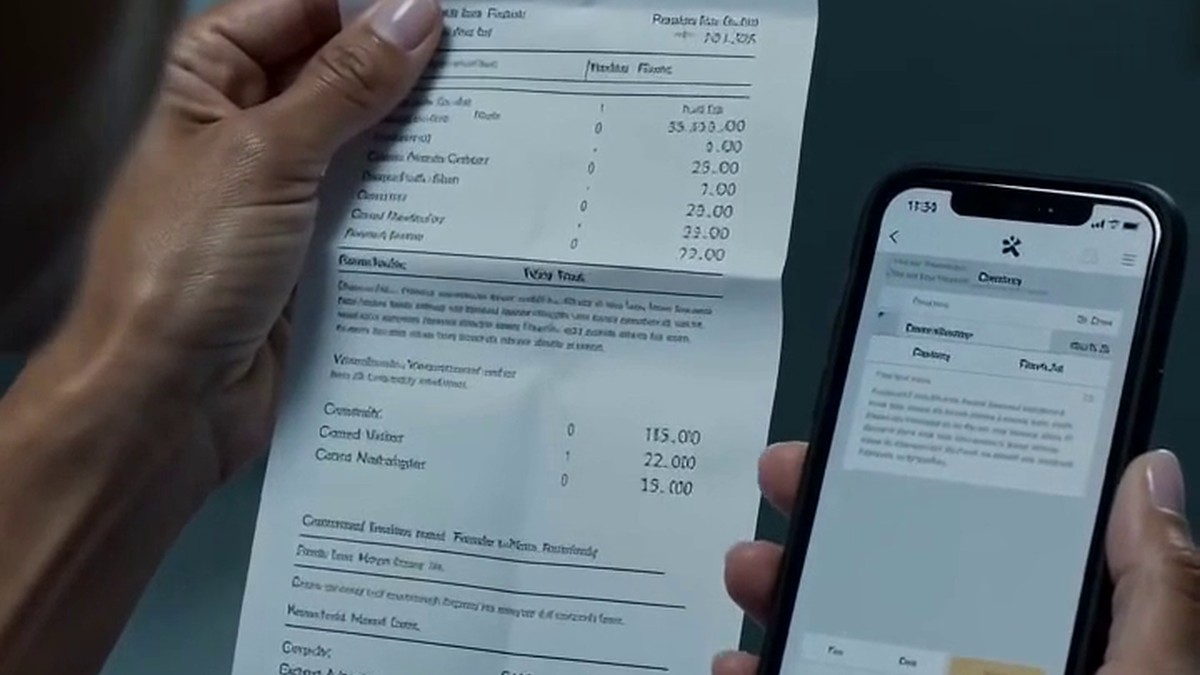
It was a wedding invoice. Cranberry Hill Estate — the vineyard venue outside Erie that books eighteen months out and charges accordingly. Two hundred and forty guests. Top-shelf open bar. A five-tier cake from a bakery whose Instagram I actually followed, because I liked their work, before I understood I'd be paying for someone else's slice of it.
At the bottom, in Derek's handwriting: *Wire the rest to Cranberry Hill before Saturday. Don't forget the florist deposit.*
Saturday. His sister Paola's wedding — the one she'd been telling everyone, for months, she was scaling back because money was tight. City hall, she'd said. Maybe forty people.
I called him.
"How's your dad doing?"
"Resting." Too clipped, too quick.
"Can I talk to him?"
A pause that lasted one beat too long. "Not right now."
"Then put your mom on."
His voice dropped into something I hadn't heard before — not anger, more like a trapped animal. "Mariana, don't do this. I'm busy." Then the line went dead.
Paola didn't pick up. Carol didn't pick up. I tried his cousin Nate, his aunt Denise, anyone. Nobody answered a single call. The silence had a shape to it, and the shape was: *everybody already knows, and it isn't you.*
That night I lay in bed scrolling Instagram until 2 a.m., watching for a crack in the wall. Around midnight I found it — a story from a second cousin, string lights over a barn, a caption that read: *So ready to celebrate our girl tomorrow. 🥂*
By ten the next morning, the venue's own photography team was streaming the ceremony live on Facebook, the way vineyards do now to sell packages to the next bride scrolling by.
I watched Paola walk down an aisle lined with white hydrangeas in a dress that had clearly never seen a discount rack. Carol sat in the front row — not resting, not recovering from anything, laughing with a mimosa in her hand. Derek stood near the reception line in the navy suit I'd steamed for him myself, shaking hands, grinning for a photographer who had no idea he was documenting the end of my marriage.
Somewhere off-camera, a guest asked, "Mariana couldn't make it?"
Carol's answer floated clear across the mic pack. "It's for the best, honestly. Not everyone fits into a family like ours."
Derek was standing right there. He heard it. He didn't correct her. Didn't even flinch.
He just let it sit.
I closed the laptop and sat on the kitchen floor of the apartment I'd paid two-thirds of the rent on for six years, and I cried — not over the wedding, not even over the lie. I cried because I finally understood I'd spent six years trying to earn a seat at a table where the chairs had never once been set for me.
When the sun came up, I did the thing I probably should have done a year earlier. I opened the banking app.
Every direct deposit was there — my salary from the hospital system, my per diem shifts, the small bonus I'd gotten in March. And beneath it, a string of outgoing transfers I hadn't authorized: Cranberry Hill Estate, $8,400. Blossom & Bough Florals, $2,150. A catering deposit for $6,700. All pulled from the joint account I'd funded almost single-handedly because Derek's contractor income was "unpredictable."
My money. Financing the exact celebration I'd been quietly erased from.
I didn't cry again. I made coffee, sat at the kitchen table with my grandmother's chipped mug, and started making calls of my own — to a divorce attorney named Renata Cole, whose office was two blocks from Mercy Hospital where I worked nights.
**PART 2: THE LEDGER**
Derek came home four days later, sun-pink from an open bar he'd apparently enjoyed on my dime, expecting the apartment — and me — exactly as he'd left them.
He found neither.
The first thing he noticed was the missing suitcase in the hall closet, the one I kept packed for overnight shifts. The second thing he noticed was Renata Cole's business card on the kitchen counter, next to a manila folder with our joint bank statements printed and highlighted in yellow.
"What is this?"
"That's forty-one thousand dollars," I said, not looking up from the folder. "That's how much I've put into that joint account since we got married, above what you've put in. That's the receipt for your father's colonoscopy I paid for in 2022, thinking it was actually your father's colonoscopy. That's the wire transfer to Cranberry Hill Estate, dated the day before you told me your mother needed rest."
He set his keys down slowly. "Mariana—"
"I watched the livestream, Derek. I heard what your mother said. I heard you say nothing back."
His jaw worked like he was choosing between three different lies and couldn't land on one. "It wasn't like that. Paola needed help, my mom asked me to keep you out of it because things get tense, and I just — I didn't want a scene."
"You didn't want a scene," I repeated. "So instead you let two hundred and forty people believe I chose not to be there. You let your mother say I don't fit in your family, on a livestream, with a microphone on her collar, and you didn't say one word."
"I'll talk to her. I'll fix it."
"You don't need to fix anything with her. I'm not asking you to defend me to your mother anymore. I'm done asking for that."
I slid the folder toward him. Renata had already flagged it — Pennsylvania is equitable distribution, not community property, but a paper trail this clean made the math simple. Dissolution filing, the joint account frozen and split according to contribution, and a formal request that the $17,250 traced directly to Cranberry Hill, the florist, and the caterer be treated as marital waste — spent by one party, without consent, for the sole benefit of a third party's celebration.
"You're actually doing this over a wedding," he said, and something in his voice tried for wounded.
"I'm doing this over six years," I said. "The wedding's just the receipt."
He tried the soft voice next — the one that used to work, the one from the doorway the morning he left. I let him talk. Then I told him the locksmith had already been by that afternoon and rekeyed the deadbolt; his things were in two boxes by the door, and he had until Sunday to get them, because Sunday was when I was changing the account passwords Renata told me I was legally entitled to change immediately.
He left with the boxes. He didn't come back for the argument he clearly wanted.
Three weeks later, Carol Whitfield called me directly for the first time in six years of marriage. I let it go to voicemail. She wanted to "clear the air," to explain that of course I was always welcome, that this was all a misunderstanding blown out of proportion.
I didn't call back. I didn't need to. The freeze on the joint account had already bounced the last installment payment to Cranberry Hill Estate, and the venue's finance office — not me, not Derek, just an automated collections email — had sent Carol's own address a polite notice about an outstanding balance of $3,100 still owed on her daughter's reception.
I found out about that part secondhand, from a cousin who couldn't resist texting me the screenshot.
I didn't gloat. I didn't reply to the text. I just closed the joint account for good the following Monday, took my half of what was left — $19,600 — and opened a new one in my name only at the credit union on Forbes Avenue, the one with the mural of Pittsburgh's three rivers painted across the lobby wall.
The teller asked if I wanted a debit card with a design on it. I picked the one with the bridges.
That night I sat on my own couch, in an apartment that would be entirely mine come January, and ordered myself a very ordinary Tuesday dinner — Chinese takeout, extra fortune cookie because the delivery guy always throws one in. I didn't read the fortune. I just liked having it there, folded next to the receipt, proof that some things could still be small and easy and mine alone.