**The Keypad Code**
I remember the exact day Marlene decided I wasn't a son-in-law anymore. I was just the man who'd stolen her daughter. Eleven years married to Dana, and every single Sunday, without fail, her mother appeared on our porch like a weather system that didn't care about the forecast.
This particular Sunday, I was underneath my truck. A 2009 Silverado with a transmission that had been giving me grief for months. I had grease up to my elbows, sweat dripping into my eyes, and exactly forty-five minutes to finish before my shift at the warehouse in Tacoma.
The screen door creaked.
"Yoo-hoo!"
That voice. That sing-song, two-note announcement that meant my afternoon was no longer mine. I slid out from under the truck, wiping my hands on a rag that was already too dirty to help.
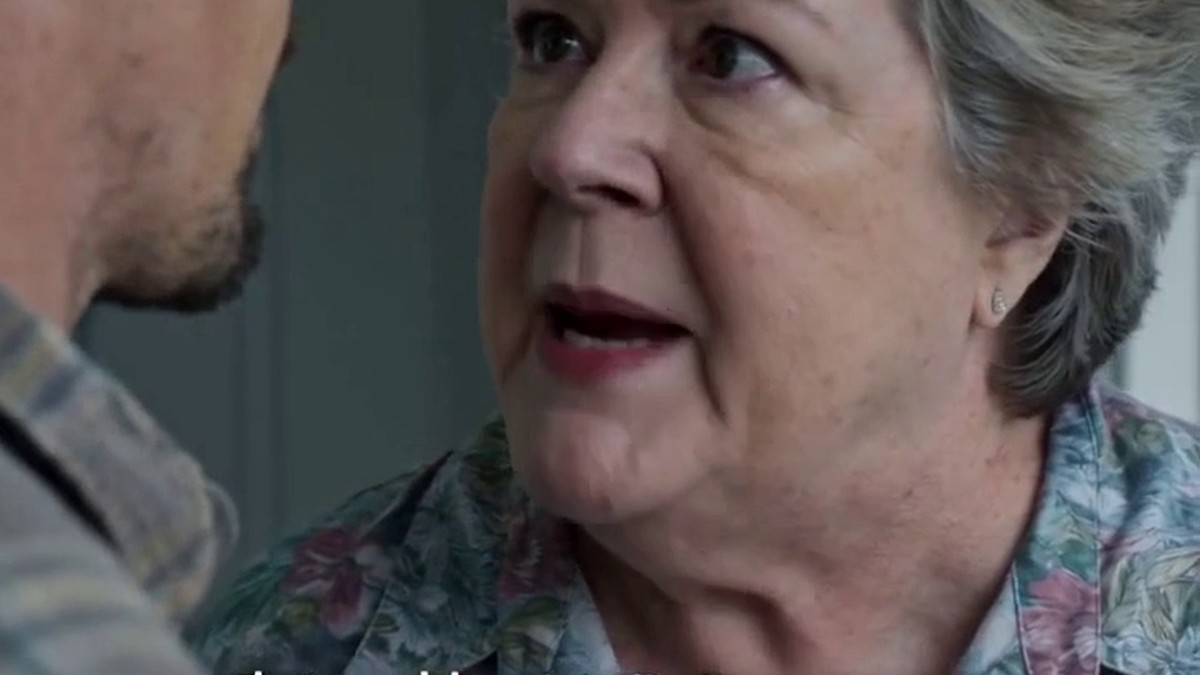
Marlene stood on the porch in her church clothes, holding a Tupperware container of something that was probably ambrosia salad. She was seventy-one, built like a fire hydrant, and had the uncanny ability to appear whenever Dana and I were having a rare moment of peace.
"Don't get up," she said, even though I was already standing. "I was just in the neighborhood and thought I'd drop off this little thing for Dana. Is she home?"
Dana was at the kitchen table, doing the monthly bills. I could see her through the window, her reading glasses perched on her nose, the calculator between her fingers. She looked up when she heard her mother's voice, and something in her face shifted. Not annoyance exactly. More like the practiced patience of a woman who'd spent forty-one years managing this particular relationship.
"She's busy, Marlene," I said. "We've got a lot going on today."
"Oh, I won't stay long." She was already reaching for the door handle. "Just want to see my girl."
Here's the thing about Marlene. She didn't knock. Not once in eleven years. She just walked in. Claimed it was her right as a mother. Claimed a closed door in her daughter's house was just a suggestion. And every time, Dana would give me a look that said *please don't start*, and I'd swallow whatever was burning in my chest and go back to whatever I was doing.
But that Sunday was different. Because two days earlier, I'd come home from my shift to find Marlene in our bedroom.
Not just in our bedroom. Going through our closet.
She'd said she was looking for a sweater she'd left. A sweater. In our bedroom closet. Behind my wife's winter coats. Three feet from the dresser where we kept things that were none of her goddamn business.
"It's not right," I'd told Dana that night. "She doesn't respect any boundary we try to set."
Dana had sighed, tired and defensive at the same time. "She's my mother, Rick. She's lonely. Dad's been gone six years."
"She's not lonely. She's territorial."
I didn't know how right I was.
Marlene lived four blocks away in a house that had belonged to her parents. She had her own car, her own friends, her own life. But she treated our house like an annex of hers. She had opinions about our furniture. Our groceries. The way I parked my truck in the driveway because the garage was full of her things — boxes she was "just storing for a while" that had been there since 2019.
So when she walked through our door that Sunday without knocking, something in me just snapped. Not the loud, dramatic kind. More like the click of a latch finally catching after years of not sitting quite right.
I walked past her into the house. Dana looked up from her bills, bracing for whatever was about to happen. That's the part that still gets me. She knew. She knew her mother was going to push, and she was bracing for it like weather she'd learned to expect.
"Marlene," I said, my voice steady, "why don't you sit down."
She did, settling into our recliner like she owned it. Which, I realized, she basically did. The whole house felt like it was hers. Her perfume had gotten into the couch cushions. Her reading glasses sat on our coffee table from her last visit.
I went to the kitchen and pulled a key off the hook by the back door. Our spare. The one she'd used for years to let herself in whenever she felt like it.
Then I walked to the front door and slid the deadbolt.
"This isn't working," I said.
Marlene looked at me over the rim of her teacup. "What isn't, dear?"
"The key thing. The coming and going. It's not working for me. Or for Dana."
She set the cup down with a little clink that somehow managed to sound dismissive. "I don't know what you're talking about. I'm her mother."
"And I'm her husband."
Dana had stopped typing on the calculator. The house was so quiet I could hear the refrigerator humming from the kitchen.
"I found you in our bedroom Wednesday," I said. "In our closet. You didn't ask. You don't ever ask."
Marlene's face did something complicated — confusion first, then a flash of injury, then the familiar mask of long-suffering patience. The mask that said *here we go again, Rick being difficult*.
"You're making this into something it isn't."
"Am I?" I pulled out my phone and read from a note I'd made. "Last month, you came over twelve times. Only three of those times did you call first. You have a key to our house that we never should have given you, and you use it like you live here."
"I'm family," she said, and there it was. The wall. The unbreachable certainty that blood meant access, that being Dana's mother gave her a permanent backstage pass to our lives.
"Family calls first. Family knocks."
I held up the key that had been on the hook. "This is our spare. Dana's and mine. We need it back."
Marlene's laugh was short and breathy. "You can't be serious."
"Dead serious." I held out my hand. "The key, Marlene."
She looked at Dana, who hadn't said a word. My wife's face was pale, her fingers gripping the edge of the table like she was holding herself in place.
"Rick." Dana's voice was barely above a whisper. "Maybe we should—"
"No." I didn't raise my voice, but something in it stopped her. "We've been 'maybe we should-ing' for eleven years. Either we have a home that's ours, or we're living in your mother's guest house."
Dana's jaw tightened. I could see the war going on behind her eyes — the daughter fighting the wife, the lifetime of conditioning pushing against the truth we both knew.
Marlene stood up, smoothing her skirt with hands that had gone white-knuckled. "I have never been so insulted in my life."
"All I'm asking is that you knock. That you call. That you treat our home like it's not yours to walk into."
But she wasn't hearing me. She was gathering her purse, her face a sculpture of wounded dignity, and I knew exactly how this was going to play out. Marlene had a gift for twisting every reasonable boundary into an attack on her motherhood. By dinner, half the family would know that Rick had thrown her out of the house. By Friday, Dana's sister would be calling to tell her what an ungrateful daughter she was.
"That's it," Marlene said, already at the door. "You'll see. You'll see what happens when family starts treating each other like strangers."
The door closed behind her with a small, decisive click.
Dana didn't speak for a long moment. Then she took off her reading glasses and rubbed her eyes with the heel of her hand.
"Jesus, Rick."
"I know."
"She's going to make this horrible."
"I know."
But then she did something that surprised me. She stood up, walked to the hook by the back door, and opened a small wooden box I'd made in my shop years ago. Inside were the rest of our keys — the one for the shed, the one for her old Civic, and years of accumulated randomness.
She pulled out a key with a little heart-shaped keychain on it. Her mother's. The one Marlene had given us to her house when we first got married. The one we'd never used because Marlene always came to us.
"Here," Dana said, pressing it into my palm. "If she doesn't need to knock on our door, we don't need one to hers."
The next day, I did what I should have done years earlier. I went to Home Depot, bought a new deadbolt with a keypad, and installed it in forty minutes. The old key Marlene had wouldn't work anymore. The new code was 2009 — the year of my truck, a number my mother-in-law would never think to try.
Marlene showed up at 7:15 the next morning.
I was drinking coffee on the porch when her Buick pulled into the driveway. She marched up the steps, a casserole dish in her hands, and reached for the door.
The key didn't turn.
She tried again. Jiggled the handle. Then she saw me, sitting there in my chair, watching her.
"What did you do?"
"Changed the lock."
"You can't do that." Her voice had gone high and thin. "This is my daughter's house. I have a right—"
"You have a right to be treated with respect," I said. "So do we. Starting now."
She stood there, the casserole dish lowering to her side, and I saw Marlene actually at a loss. Not angry. Not performing. Just lost.
"Ring the doorbell, Marlene. We'll be happy to see you."
She didn't ring. She turned, walked to her car, and drove away. The casserole is still in our freezer.
That was nine months ago.
It took Marlene four weeks to come back. When she did, she rang the bell. We had coffee. She stayed an hour. It was awkward, and strained, and neither of us enjoyed a minute of it.
But she rang the bell.
Now she calls on Tuesdays. Sometimes she still comes over unannounced, but she stands on the porch and waits. Dana meets her at the door. They've started gardening together on weekends, and I watch them from the kitchen window, two women knee-deep in hydrangeas, their laughter carrying through the screen.
I don't know if Marlene ever understood why I did what I did that Sunday. She probably tells her lady friends at church that her son-in-law is difficult, that he locked her out, that he made her own daughter choose. Maybe that's true, in a way.
Last night, Dana and I sat on the back deck, watching the sun go down over the sound. She reached over and squeezed my hand. I squeezed back and didn't say anything.
Some nights, when everything is quiet, I hear a car slow down on our street. I look out, and there's Marlene's Buick, idling at the curb. She sits there a minute or two, looking at the house. Then the taillights swing away, and the street goes dark again.