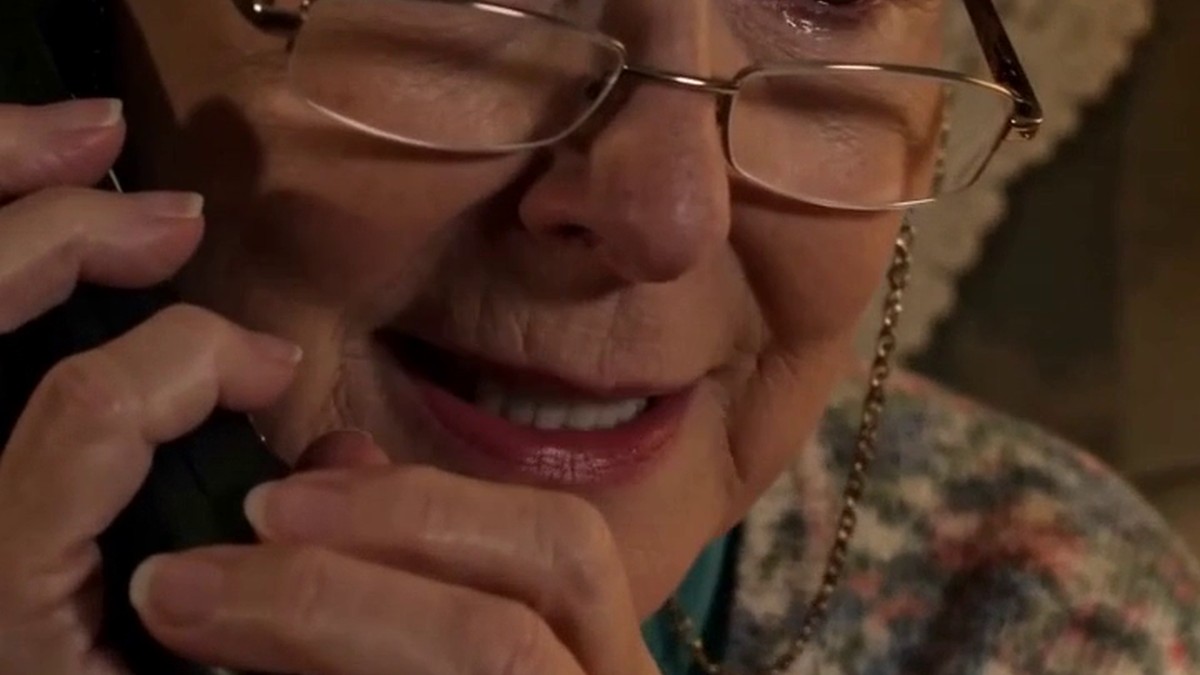
If someone had told me a week earlier that a stranger from four hundred miles away would show me more warmth than my own son, I'd have laughed. Or burst into tears. I honestly don't know which would've been worse.
The package was sitting on the porch mat when I got back from the pharmacy, my blood pressure pills in a little white bag swinging against my wrist. Plain brown box, corners a little crushed, return address in careful, slightly slanted handwriting I didn't recognize. I picked it up like it might go off. In a way, it did.
But to understand that box, I have to back up a few months.
My son Cole moved to Chicago nine years ago. Twenty-three years old, a mechanical engineering degree, and this restless, unfocused look in his eyes because there was nothing for him in Millbrook, Ohio — population six thousand, one traffic light, a Dollar General and a diner that closed at two. I ran the alterations counter at a dry cleaner then, hemming pants, replacing zippers, patching up prom dresses that girls had outgrown by June. I'm not saying I made great money. But it covered the bills, and it covered the care packages I mailed him — beef jerky, his grandmother's oatmeal cookies wrapped in wax paper, twenty-dollar bills tucked into birthday cards.
The first year he called every other day. Then once a week. Then whenever he remembered. I never complained. I didn't want to be the mother hovering on the phone asking if he was eating enough vegetables. I knew he was building something — construction sites first, then a design firm downtown, climbing. I was proud of him. When he told me he couldn't make it home for Thanksgiving, I said "I understand, honey" and hung up before my voice could crack.
Then he told me about Whitney.
He talked about her carefully, like he was testing the ground. She was an architect. Her parents had a house up near Lake Geneva, Wisconsin. Her father was a cardiologist, her mother had run an art gallery in the city for twenty years. I listened and felt something harden in my chest — not jealousy, not anger, just a quiet unease. Like Cole was laying out puzzle pieces that added up to a world I hadn't been invited into.
"Mom, I need to tell you something," he started one evening, and I already knew it wasn't good news. Not because he meant me harm. Because his voice had dropped into that register he used as a kid right before admitting he'd broken something.
They were getting married in June. At Whitney's parents' place on the lake. Small — immediate family only.
"I am your immediate family," I said.
Silence. The kind where you can hear someone hunting for words and not finding them.
"Mom, they're… a different world. Doctors, architects, people who've been to six countries. I don't want you to feel uncomfortable."
I was standing in the kitchen, one hand flat on the counter. Through the window, the neighbor's honeysuckle was blooming along the fence, and I remember the smell — thick, almost too sweet. And I remember thinking: he's not leaving me out because he doesn't love me. He's ashamed of me.
"Is this about you, or about me?" I asked quietly.
"Mom, please don't do this to me."
I didn't. I hung up, sat down at the table, and stared at the wall for an hour. I didn't cry. I was too stunned to cry.
For days afterward I tried to make sense of it. Cole had never been a cruel kid. When he was little he used to bring me dandelions from the empty lot behind the house, wrapped in a page torn from the Sunday paper like they were roses from a florist. In middle school, when the other boys teased him for wearing the same sneakers three years running, he was the one who told them to knock it off. He wasn't a bad person. He was someone who, somewhere along the way, had started measuring people by a different yardstick and lost track of himself in the process.
My neighbor Deb, the only person I told, shook her head at me over coffee. "Go anyway, Carol. Show up without an invitation. Let her see you."
I couldn't do it. Because what if he was right? What if I sat there in the one nice dress I owned — clearance rack at Kohl's — clutching my purse, not knowing which fork to use, and Whitney looked at me and thought: this is Cole's mother?
So I stayed home on the wedding day. Baked a pan of banana pudding I didn't even want, for no one in particular. Ate one bowl, brought the rest to Deb's. That night I texted him: "Congratulations, sweetheart. Wishing you both every happiness." He sent back a heart emoji. Nothing else.
A week later, the package arrived.
I cut the tape open at my kitchen table. Under a layer of tissue paper was a scarf — a soft dusty rose, with a delicate lace pattern I recognized instantly. It was the exact stitch I'd knitted twenty years earlier, out of my own mother's pattern book. Underneath the scarf was an envelope. Cream-colored, a card inside written in small, careful handwriting.
It was in German.
I picked it up and my heart was pounding. I could make out maybe every fifth word. "Sohn." "Stricken." "Entschuldigung." The rest — nothing.
I drove to Deb's. Deb had taken two years of Spanish in high school back in the seventies, which did us exactly no good, but her granddaughter Paige was a junior at Millbrook High and pulling straight A's in German for some reason nobody in the family could explain. Deb FaceTimed her, and Paige — sixteen, chipped purple nail polish, sitting on the edge of her bed with her homework spread out behind her — translated my daughter-in-law's mother's letter for me.
It read:
*Dear Carol, my name is Ingrid. I'm so sorry we didn't get the chance to meet at our children's wedding. Cole told me you knit beautiful things — I've knitted my whole life too, and I haven't had anyone to talk about it with in years. My husband thinks it's a waste of time, and my daughter has no interest. I made this scarf especially for you. I found the pattern in an old book, and I hope you like it. If you'd ever like to visit this summer, we have a guest room and a garden full of roses. It would mean a great deal to me.*
Paige looked up from the screen. "Grandma Deb, this lady sounds really sweet."
I sat in Deb's kitchen with that scarf in my lap and cried. Not from sadness — from relief. From this strange, dizzying realization that somewhere in Wisconsin there was a woman exactly like me. Who sat some evenings with knitting needles and a skein of yarn, and whose family didn't think much of it either. Who wasn't "a different world" at all. She was the same one.
That evening I called Cole.
"I got a package from your mother-in-law," I said, keeping my voice level.
Silence. The same kind as before.
"Mom—"
"You know what, Cole? Thirty years I thought I'd raised you right. And I think I did — because you turned into a man capable of loving and being loved. But somewhere along the way you lost something. You mixed up shame with protecting me."
He didn't answer right away. I could hear him breathing — slow and heavy, the way he used to breathe at eight years old trying not to cry after a fight with a friend.
"I'm sorry," he said finally.
"I know," I said. "And I think I'm going to fly out to see them this summer."
The next day I drove to the fabric store on Route 9. I bought three skeins of a deep lavender-blue yarn — the kind of blue the sky turns over an Ohio cornfield right before a storm rolls in. I started knitting a scarf for Ingrid. I picked the same pattern she'd used — the old, classic one, out of our mothers' books.
Because it turns out mothers in Millbrook and mothers on Lake Geneva knit exactly the same way.
And the world isn't nearly as big as Cole thought it was. When I finally mailed the box off — return address in my own careful handwriting, a jar of my mother's apple butter tucked in beside the scarf — I stood at the post office counter and watched the clerk weigh it, stamp it, slide it into the outgoing bin. Six dollars and forty cents. I paid it in cash and drove home with the windows down, radio on, and didn't think once about what fork I'd use.