Natalie’s fingers tightened around Chloe’s wrist just a little more than necessary.
And Chloe felt it.
Not pain exactly.
Something heavier.
Something that told her, without words, that the world outside that grip was not safe enough to trust.
And in that moment, she made a decision no child should ever have to make.
To ask for help without asking.
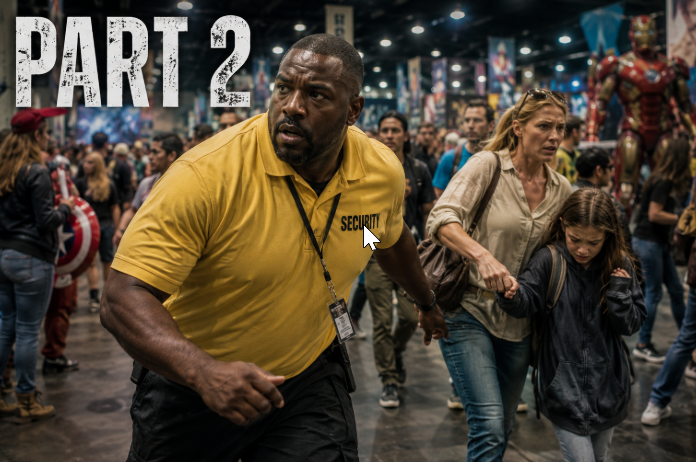
Jack Morgan saw the shift before anything else happened.
The way Natalie’s smile never reached her eyes.
The way Chloe didn’t look at the lights, or the booths, or the excitement around her.
She only looked for gaps.
Exits.
Spaces between people.
Like she was memorizing escape routes instead of enjoying a convention.
“Excuse me, ma’am,” Jack said calmly as he stepped slightly into their path near Exit Three.
Natalie didn’t slow down.
“We’re just leaving,” she replied quickly.
Her voice was polite.
Too polite.
The kind of polite that hides urgency.
Chloe walked beside her in silence.
But her hand moved once.
A small motion.
Barely noticeable.
Except Jack noticed everything now.
And that small movement changed the entire direction of the moment.
A folded drawing slipped into his palm.
Then she was gone again.
Back into Natalie’s shadow.
Jack didn’t open it immediately.
He waited until they were within sight of the exit doors.
Then he unfolded the paper slowly.
A car.
A child.
Thick red lines drawn over everything like warnings that couldn’t be erased.
And a message pressed so hard the crayon almost tore the paper:
PLEASE DON’T LET ME GO
Jack’s throat tightened.
Not from confusion.
From recognition.
Because children don’t draw like that for attention.
They draw like that when words are no longer safe.
“Control,” Jack said into his radio, voice low and steady, “hold Exit Three. I need security support immediately.”
He didn’t take his eyes off them.
Natalie was already reaching the doors.
Just seconds away.
“Ma’am,” Jack called again, stepping forward.
Natalie stopped.
Not fully.
Not willingly.
Just enough to turn.
“Yes?”
Her smile stayed in place.
But her hand moved closer to Chloe’s shoulder.
Just slightly.
Too slightly.
A female officer arrived within moments.
“What’s the situation?”
Jack handed over the drawing without a word.
The officer read it once.
Then again.
And everything in her posture changed.
“Sweetheart,” she said gently, kneeling down to Chloe’s level, “can you come talk with me for a moment?”
Silence.
Chloe looked at Natalie.
Just for a second.
That was all it took.
Not words.
Not explanations.
Just a look that carried everything she wasn’t allowed to say.
Natalie exhaled sharply.
“She’s just shy. She doesn’t understand—”
But Jack raised his hand.
Not aggressive.
Just final.
“Let her speak.”
And for the first time, Natalie didn’t interrupt.
The room they brought Chloe into was quiet.
No music.
No crowd.
Just a chair near the window and soft light falling across the floor.
Chloe sat very still.
Too still for a child her age.
Hands folded tightly in her lap like she was afraid even movement might be wrong.
And then, slowly, the truth came out.
Not in a rush.
But in fragments.
Strict rules that never felt explained.
Words that made her smaller instead of safer.
Days where silence felt like the only way to avoid trouble.
And the drawing—hidden carefully because it was the only place she could say what she was not allowed to speak.
Jack stood outside the door for a long time afterward.
He kept thinking about the same thing.
Not the drawing.
Not the crowd.
But the moment she looked at him.
That silent, desperate second where a child decided:
If I don’t do this now, I might not get another chance.
Two days later, an older woman arrived at the center.
She didn’t speak loudly.
She didn’t need to.
Her hands shook slightly as she gave her name.
“I’m her grandmother.”
When the door opened, Chloe froze.
Just for a moment.
Then everything inside her broke forward at once.
She ran.
No hesitation.
No fear.
Just recognition.
And the kind of relief that only comes when love finally arrives where it was always meant to be.
Weeks later, Jack received a letter.
Inside was a photograph.
Chloe sitting in a garden, sunlight spilling across her face, a smile that looked unfamiliar at first—
because it was new.
A smile that didn’t have to hide anything.
On the back, written carefully:
Thank you for seeing me when I couldn’t speak.
Jack held the photo longer than expected.
Not because it was extraordinary.
But because it wasn’t.
It was simple.
A moment.
A choice.
A child who finally got to be heard.
And maybe that’s the part people forget most:
Sometimes protection doesn’t begin with authority.
It begins with noticing what others are too busy to see.
What do you think changes a life more—speaking up for someone who can’t, or simply noticing in time that they’re asking for help without words?