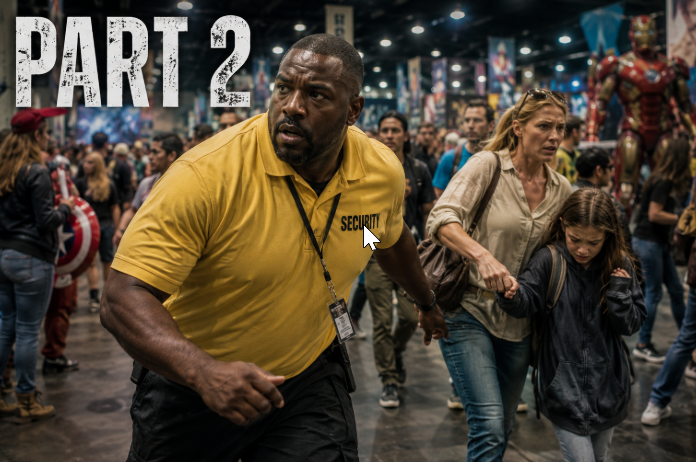
Jessica’s hands were shaking before she even realized it.
Because in that crowded hallway, surrounded by noise, laughter, and flashing lights, something in her chest suddenly told her the truth—
This wasn’t a child simply lost in a crowd.
This was fear that had learned how to stay quiet.
And now everything was moving too fast.
Or maybe it had already been moving too long.
Ryan didn’t hesitate.
He was already pushing through the crowd, radio clipped tightly in his hand.
“Control, we’ve got a situation at Exit Six. Hold all outbound movement.”
His voice was steady.
But his eyes weren’t.
Because he was watching Jessica’s grip on the child tighten just a fraction too much when she noticed the staff presence.
Just enough to matter.
“Excuse me, ma’am,” Ryan said as he stepped into her path.
Jessica stopped.
Not fully.
Not relaxed.
Just paused—like someone forced to pause mid-step.
“We’re just leaving,” she said quickly.
Ava stood beside her.
Still.
Too still.
Ryan knelt slightly, lowering his voice.
“Hey, sweetheart… are you okay?”
Silence.
Then Ava’s fingers moved.
Small. Careful.
And she placed the folded paper into his hand like it weighed more than it should.
Ryan opened it.
A child’s drawing.
A car.
Thick red lines across the page.
And a message pressed so hard the crayon had torn the paper:
DON’T LET HER TAKE ME HOME
His stomach dropped.
Not from surprise.
From recognition.
Because children don’t draw like that for attention.
They draw like that when they believe no one else is listening.
Behind him, another officer arrived.
“What’s going on?”
Ryan didn’t look away from the drawing.
“She’s not safe,” he said quietly.
And somehow, those four words changed the entire air around them.
Jessica exhaled sharply.
“That’s ridiculous. She’s my daughter. She’s tired, that’s all.”
But her voice wasn’t steady.
It was controlled.
Too controlled.
A detail Ryan didn’t miss.
He had seen that kind of control before—in situations where control was the only thing left to hold onto.
Ava’s eyes flickered up.
Just once.
And in that glance, Ryan saw something no report could explain.
Not rebellion.
Not confusion.
Relief.
Like she had finally been seen.
“Sweetheart,” a female officer said softly, stepping closer, “can you come with me for just a moment?”
Ava hesitated.
Her small hands trembled.
Then—slowly—she stepped away from Jessica’s side.
No running.
No drama.
Just quiet movement toward safety.
And that silence said more than words ever could.
The room they brought her into was small.
Soft light.
A chair by the window.
No crowd. No noise.
Just space.
And for a long time, Ava said nothing.
She only stared at her hands.
As if waiting for permission to exist without fear.
Then it came.
Not everything.
Just enough.
Lonely days.
Strict rules that didn’t feel like rules meant for a child.
The feeling of walking on invisible glass.
And the drawing—carefully hidden, carefully made—because it was the only place her voice could survive.
Ryan stood outside the room afterward, still holding the folded paper.
He couldn’t stop looking at it.
Not because it was dramatic.
But because it wasn’t.
It was simple.
A child asking not to disappear.
Days later, a woman arrived at the care center.
Older.
Tired eyes.
Hands shaking before she even spoke.
“I’m her grandmother,” she said softly.
And when they opened the door—
Ava didn’t hesitate.
She ran.
Not halfway.
Not unsure.
All the way.
Straight into arms that had been waiting longer than anyone should have to wait.
Later, in a quiet office, the grandmother held Ava’s small hands like she was afraid the world might take them away again.
“I looked for you,” she whispered. “Every day.”
Ava nodded against her shoulder.
“I knew you would.”
And in that moment, something inside the room finally softened.
Weeks later, Ryan received a letter.
No official stamp.
No formal wording.
Just a child’s handwriting.
A little uneven.
A little messy.
Inside was a photo of Ava in a sunlit garden, hair loose, smile real.
On the back, three words:
Thank you for noticing.
Ryan read it twice.
Not because he didn’t understand it.
But because he did.
Because sometimes the most important rescues don’t begin with alarms or procedures.
They begin with someone looking at a child and realizing:
Something about this silence is asking for help.
And in a world full of noise…
that kind of noticing is everything.
What do you think is harder in life—protecting someone in danger, or realizing in time that they need help at all?